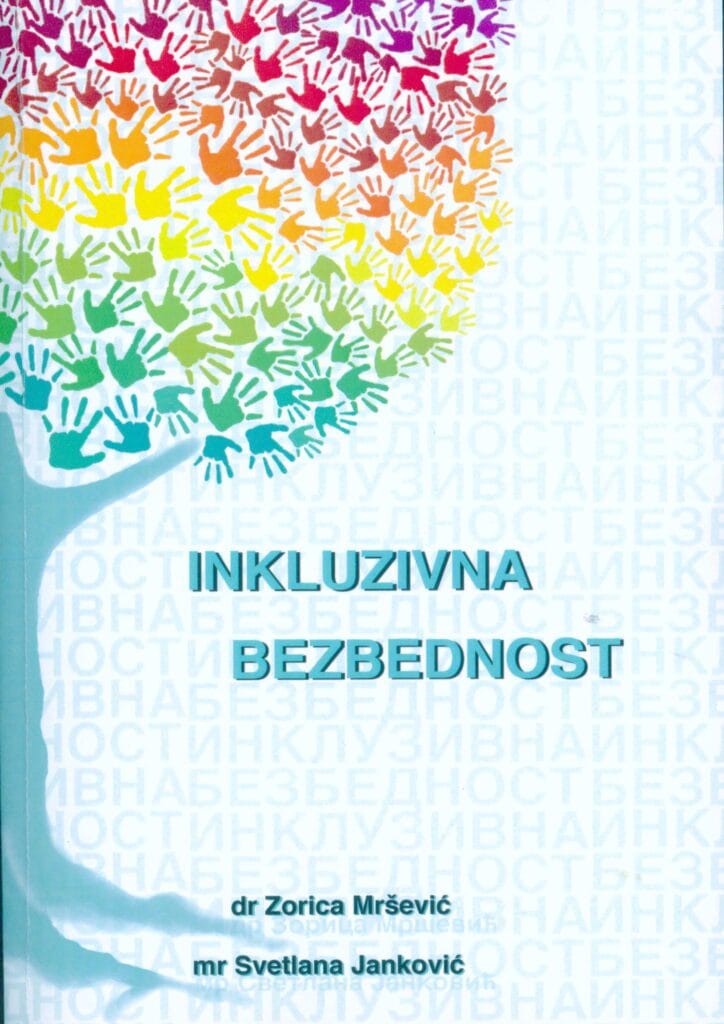
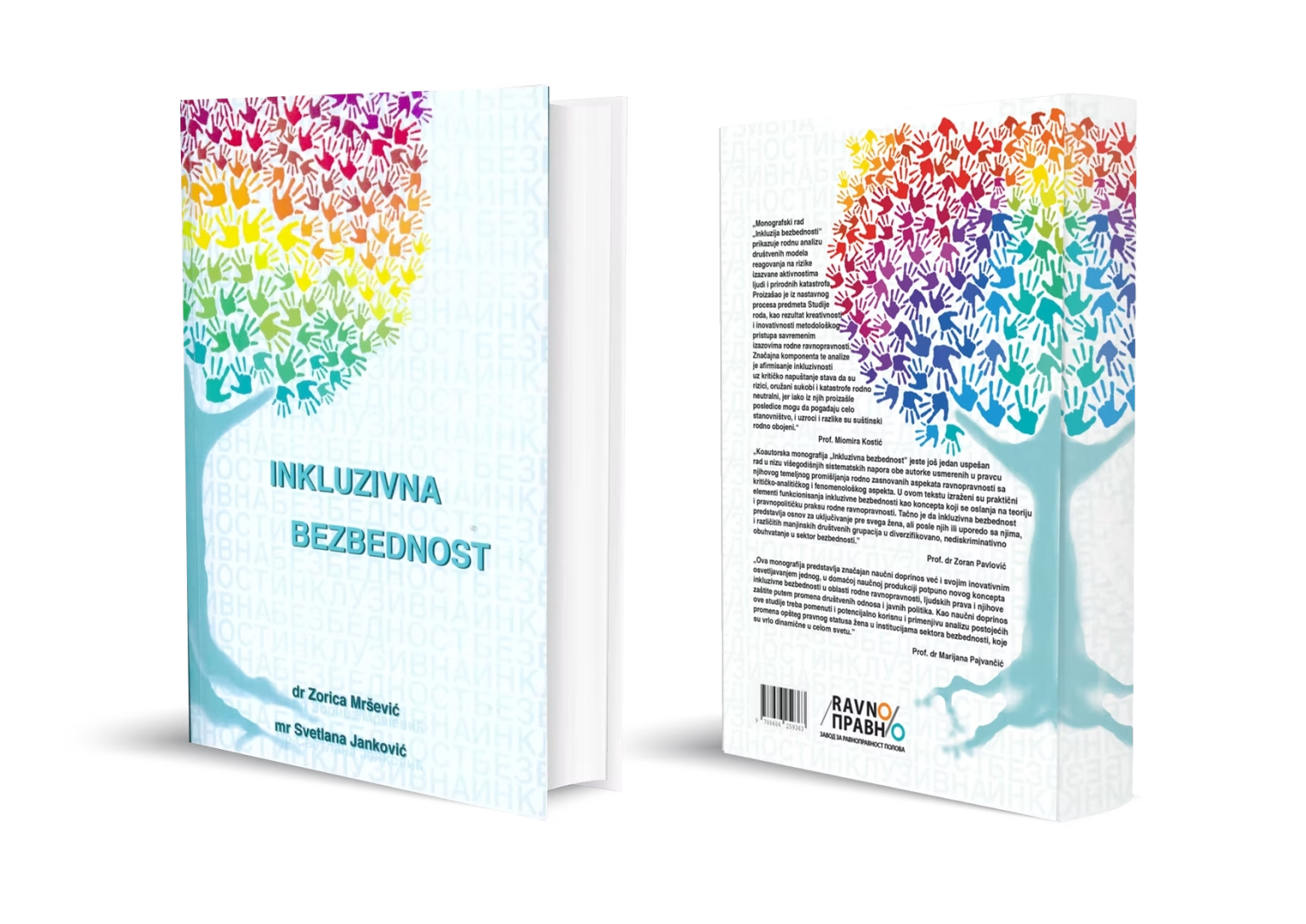
Inkluzivna bezbednost = ИНКЛУЗИВНА БЕЗБЕДНОСТ
Mršević Zorica, Janković Svetlana 2021.
Novi Sad: Pokrajinski zavod za ravnopravnost polova.
ISBN: 978-86-86259-36-3
COBISS.SR-ID: 51011081
Inkluzivna bezbednost je intergralni deo nastavnog procesa predmeta Studije roda koji se predaje na Fakultetu za evropske pravno-političke studije u Novom Sadu. Deo je savremenog koncepta nastavnonaučneoblasti Studija roda (gender studies) koji se u promociji rodne ravnopravnosti integrativno i sinergično nastavlja na velike, klasične teme Ženskih studija i Studija roda, zaštita žena od rodno zasnovanog nasilja i politička participacija žena. Koncept inkluzivne bezbednosti takođe je deo savremenih promena u oblasti studija bezbednosti koje se odnose na uvođenje tzv. ljudske dimenzije bezbednosti u mušku, vojnocentričnost međunarodnih odnosa vojno političkih elita kao tradicionano ekskluzivnih državnih aktera rata i mira. Monografija Inkluzivna bezbednost sadržinski obuhvata tri osnovne teme: inkluziju u sektoru bezbednosti i međunarodnim odnosima, inkluzivnost savremenih oružanih snaga i inkluzivnost u domenu smanjenja rizika od katastrofa. Njena osnovna poruka je neophodnost da u sve te procese svih nivoa budu uključene žene kao ravnopravne učesnice i akterke.
Ključne reči: rodni aspekti oružanih sukoba, rod i kreiranje mira, rodni odnosi u vanrednim situacijama, prirodne katastrofe i rod, humanizacija bezbednosti, reforme sektora bezbednosti, žene u vojsci, žene u postkonfliktnim društvima, savremeni bezbednosni izazovi, društva diversifikovanog sastava, UN SB Rezolucija 1325 žene, mir, bezbednost
PRILOZI
INKLUZIVNA BEZBEDNOST PDF KNJIGA
Summary in English
Inclusive security is a contemporary concept based on the teaching-research fi eld of gender studies, which, in promotion of gender equality, ontinues great, classical topics of gender studies, such as women’s protection from gender-based violence and women’s political participation. Th e concept of inclusive security is also part of the contemporary changes of security fi eld studies which comprises introduction of human dimensions to security in the military-centred international relations of state as the main subjects. Th e contents of this paper covers three main topics: Inclusion in the security sector and international relations, Inclusion of contemporary armed forces and Inclusion in the fi eld of disaster risk reduction.
Gender is the primary concept of organizing society; therefore, the gender dimension must be taken into account if we want to gain insight into the position of all people who fi nd themselves in emergency situations caused by either armed confl icts or natural disasters (Cvetković and Svrdlina, 2020: 45). Already at the Fourth World Conference on Women in 1995 and the adoption of the Beijing Platform for Action in 1995, attention was focused on women’s gender roles in peace and security, thus creating the necessary political will and support for gender mainstreaming in all aspects of post-confl ict confl ict, recovery and peacebuilding. Th is has expressed increasing dissatisfaction and disappointment, since the end of the Cold War, with the usual approach to security issues, which was based on the inviolability of the state and military-centric paradigm. Feminist critiques of traditional security and, in particular, its alleged gender neutrality, have provided further impetus for security rethinking. Since then, it has been increasingly pointed out that „women hold half the sky“, and that the violence of armed confl icts and wars aff ects them the most (Reddy, 2010: 7), which opened the way for the concept of inclusive security.
The next inevitable step was in the form of „humanization“ of security in accordance with people and their needs, which required the construction of human dimensions of peace management policies and processes, focusing on freedom from fear and concern for human life and dignity (Villellas et al., 2018). Th is expressed the need to move beyond disarmament and road repairs, re-establishing the free flow of goods and helping refugees return home. It has proved necessary to strive for real and inclusive „positive peace“, which includes reconciliation, respect for the rule of law, free elections, equal political and social opportunities, freedom of the media, civil society participation, economic growth, which means more than just service delivery to implementation of peace, but in fact, the implementation of the ideas of lasting peace in action.
Since the late 1990s, the concept of security sector reform has increasingly shaped international programs for development assistance, democracy promotion, security cooperation and post-confl ict peacebuilding. A poorly run and unreformed security sector is a signifi cant obstacle to promoting sustainable development, democracy, peace and security. What has been lacking to date is a common, comprehensive and coordinated approach to UN security sector reforms, spanning the full spectrum of peacebuilding, including long-term development, with common principles, objectives and guidelines for development and implementation supported by the UN and clarity on roles (DCAF, 2006) and responsibilities within the UN system.
Yet, in the 21st century, the focus of international confl ict management is increasingly shifting from peacekeeping, which is about maintaining the status quo, to peacebuilding, which is linked to transition management. Most of the UN peacekeeping operations since 1989 have actually been
peacebuilding operations, with a focus on supporting and implementing comprehensive peace processes. Th is included classic peacebuilding tasks such as disarmament, demobilization and reintegration, judicial reform, election organization, training and restructuring of new police forces and
facilitating the transition, from interim to transitional and ultimately to democratically elected governments. Developments from peacekeeping to peacebuilding have included mostly civilian dimensions added to traditional military peace mandates. Th ese new dimensions were aimed at helping the host country maintain the momentum of the peace process (De Coning, 2007). Where wars and ethnic confl icts have irreversibly shaped the past, they inevitably shape the present, and even further, the future. Th e present living awareness of the fact that the past is a fl exible saga is needed, in order to imagine the future in accordance with human values (Meegaswatta, 2021).
Today, there are generally three diff erent notions of human security: fi rst, previously focused on human losses in armed confl icts, second, the later developed, emphasizing human needs on the path to sustainable development and the third, comprising the primacy of the human rights dimension (Reddy, 2010). Both the second and the third understanding contain the necessary component of inclusive security, which necessarily includes women as actors. Eff orts to end armed confl icts peacefully and address their root causes will fail unless all those who have suff ered because of them are strengthened – especially women. And only if women play a full and equal role can the foundations be built for the lasting peace development, good governance, human rights and justice (Annan, 2002). In confl ict areas around the world, women’s movements have since worked with the United Nations to rebuild peace and security structures, rehabilitate and reconcile societies, protect refugees and internally displaced persons, educate and raise awareness of human rights and the rule of law. Within the UN itself, the integration of gender perspectives into peace and security areas has become one of the applied strategies. Although many positive steps have been taken since then, women still form a minority of those who participate in peace and security negotiations, while in post-confl ict agreements, disarmament and reconstruction, they get signifi cantly less space than men.
The opportunity created by confronting the domains of private and public life of women in sub-confl ict societies not only raised their awareness, self-esteem and involvement in providing livelihoods but also expanded their impact on confl ict resolution and peacebuilding processes, thus opening previously closed domains for women. Th ese positive outcomes in this process of engaging women to establish their subjectivity and negotiate „opening space“ for themselves have been refl ected at the formal and informal levels of society (Boyd, 2007).
Natural disasters and confl icts do not aff ect all people equally. In many parts of the world, much more women than men die in such disasters, due to greater poverty and other forms of discrimination. Also, women after a natural disaster or war confl ict also become victims of sexual and domestic
violence (UNDP, 2018). Th e increased vulnerability of women, in disasters and confl icts, is diffi cult to reduce without changing the capabilities of aff ected women. Gender-sensitive programming is necessary because gender equality is essential so that women are not treated only as passive objects of rescue and assistance. Women are more likely to be victims of post-disaster situations, as each disaster has a different wave, caused by inadequate response strategies, which can be identifi ed as a „social problem caused by humanitarian aid“. Therefore, an important developmental challenge in rehabilitation is the need to improve the social status and abilities of women belonging to diff erent socio-cultural groups. Women
in disasters and confl icts, after these events, are the key to the door of return to normalcy. While making such eff orts, they are exposed to abuse and violence, as well as restrictionism in diff erent contexts, by family members, workers, government staff and relief agencies (Subhasis, 2017). This
paper emphasizes the need for more responsible and efficient involvement, information and motivation of political leaders and women to be engaged in decision-making and management of natural resources, environmental protection and disaster risk prevention. The inclusion of gender component
in local communities must be recognized as necessary in the field of disaster risk reduction, given that the development of the protection and rescue sector in order to improve safety is still not adequately gender-inclusive (Mršević and Janković, 2018: 408).
In the current times when many „phobias“ are entering our lives and public discourse, caused by increasingly uncertain prospects for the future, especially given, three main global crises, the pandemic Covid19, climate change and the migrant crisis, there is a demand to rethink the potential of gender equality concept. Th is reconsideration actually means the introduction of the concept of inclusive security, as a theoretical and methodological framework for critical refl ection on dynamic relations and categories of power inequality, through the interdisciplinary prism of security theory and gender theory. It is necessary to emphasize that it is necessary to be aware that the prevention and suppression of multiple discrimination against women are further developed and implemented in laws and public policies, in order to make the best use of their transformative potential and prevent the perpetuation of inequality. Th erefore, it is necessary to look deeper into these topics, multidisciplinary and
interdisciplinary, in order to adequately respond legally and politically to the multiple inequalities and inconveniences to which certain groups of women are exposed in situations of armed confl ict and disaster.
The view of achieving gender equality in pandemic conditions by the McKinsey Global Institute team emphasizes the need for a better understanding of the relationship between women in society, women at work and in economic growth – especially factors driving job loss and women’s professional recovery. More employed women is a condition of socially and economically benefi cial progress, not cost. Measures designed to foster greater gender equality, even as the COVID-19 crisis continues, benefit not only women through the promotion of gender equality, but are also benefi cial to overall economic growth. Companies that implement measures for gender equality achieve gender diversity, which, in turn, contributes to their resilience and the ability to recover faster from the crisis. Th e goal is to improve access to talents of both sexes, diff erent skills, leadership styles and planning perspectives.
This crisis, however, provides an opportunity to reflect on the world we want to live in, the world free of gender-based violence, where people and solidarity are priorities over capital and corporate interests. Maybe it is already preparation for a great battle leading to a new reality, which we cannot even imagine, but we are slowly realizing that nothing will be the same like before. Th at is why it is necessary to get the best out of this crisis, which is a kind of crisis of humanity. It is inevitable that the consequences of the pandemic will be visible in all areas of society. It is clear: there is a big test in front of everyone. In addition to disinfecting hands and space, it is also time to disinfect the very concepts, strategies and even the thoughts themselves.
More than ever, there is a need for awareness that equality and empowerment of women have immeasurable positive eff ects on society as a whole. Progressive forces, from parties to unions, from academia and research bodies to human rights and feminist organizations, are now ready for their biggest rehearsals – whether they will be able to discuss solutions during and after COVID-19. Legal regulation and legal protection of the sphere of private life today require not only a professional, but also a creative approach to the development of a system of legislation that can introduce an
adequate legal basis. If not, it would mean renouncing the centuries-old struggle of generations of women for equality, social justice, democracy and human rights. Women and men deserve better. A better legacy must be left to generations to come. A possible way out and hope are found in women
who are supported, because today, more than ever, feminist principles, human ethics of caring for oneself and others are needed, with much-needed publicity of work, added by solidarity and cooperation.
It is best to end the presentation on inclusive security with the following slogan, „What is good for gender equality is good for the economy and society as a whole.“ (McKinsey Global Institute, 2021).